Catholic Center at UGA - All are welcome here

Eucharistic Adoration

Eucharistic Adoration

"We have come to do him homage."  Those words, spoken by the Magi from the East as they searched for the infant Jesus, resound through the centuries to be echoed in the heart of every person who makes a visit to the Blessed Sacrament.  The presence of Our Lord in the Blessed Sacrament is as real today as the infant Jesus was to the Wise Men who sought Him by following a star rising in the East.  As Pope John Paul II affirms in his encyclical on the relationship of the Eucharist to the Church, "... the gaze of the Church is constantly turned to her Lord, present in the Sacrament of the Altar, in which she discovers the full manifestation of his boundless love."  (The Church and the Eucharist, 1)


What is Eucharistic Adoration?

Eucharistic adoration is the act of worshiping Goad as He is present in the consecrated Eucharist.  Since the Last Supper, when Jesus broke the bread and distributed the wine, saying, "This is my Body" and "This is my Blood," Catholics have believed that the bread and wine are no longer merely baked wheat and fermented grape juice, but the actual living presence of the Second Person of the Trinity.  Spending time before the Blessed Sacrament, in prayer and devotion, is exactly the same as spending time before the living God.  Adoration occurs whenever someone kneels in front of a tabernacle that contains the Blessed Sacrament, genuflects toward a tabernacle, bows before receiving the Blessed Sacrament at Mass or, in a more focused way, when the Blessed Sacrament is exposed for adoration.


Exposition of the Blessed Sacrament

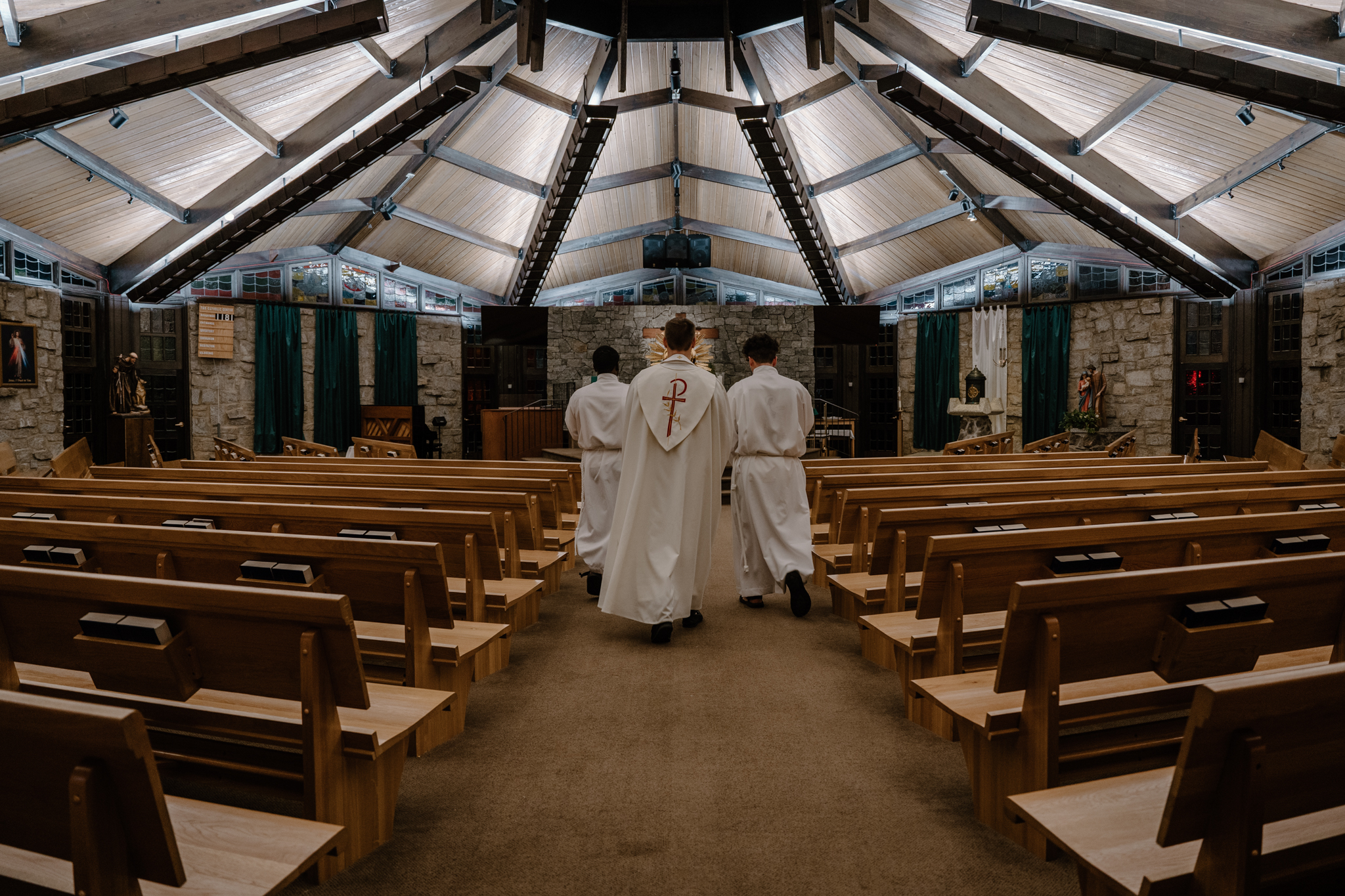
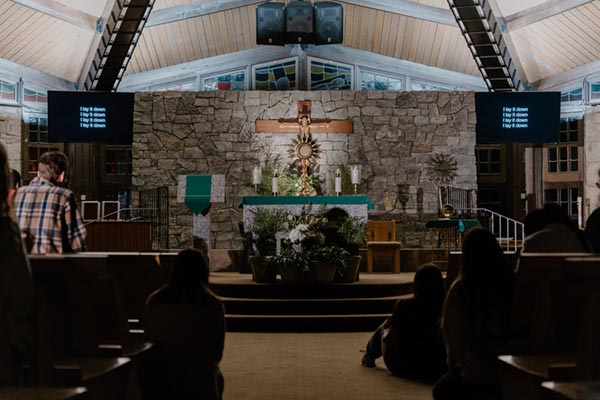
The devotion begins with exposition of the Blessed Sacrament.  A priest or deacon removes the sacred host from the tabernacle and places it on the altar for adoration.  The purpose of adoration is to highlight the presence of Our Lord in the Eucharist.  When a consecrated host is placed in the monstrance, it is said to be a solemn exposition.  Adoration ceremonies traditionally include Scripture readings, hymns, prayers and time for silent adoration.


Ways to Celebrate Eucharistic Adoration


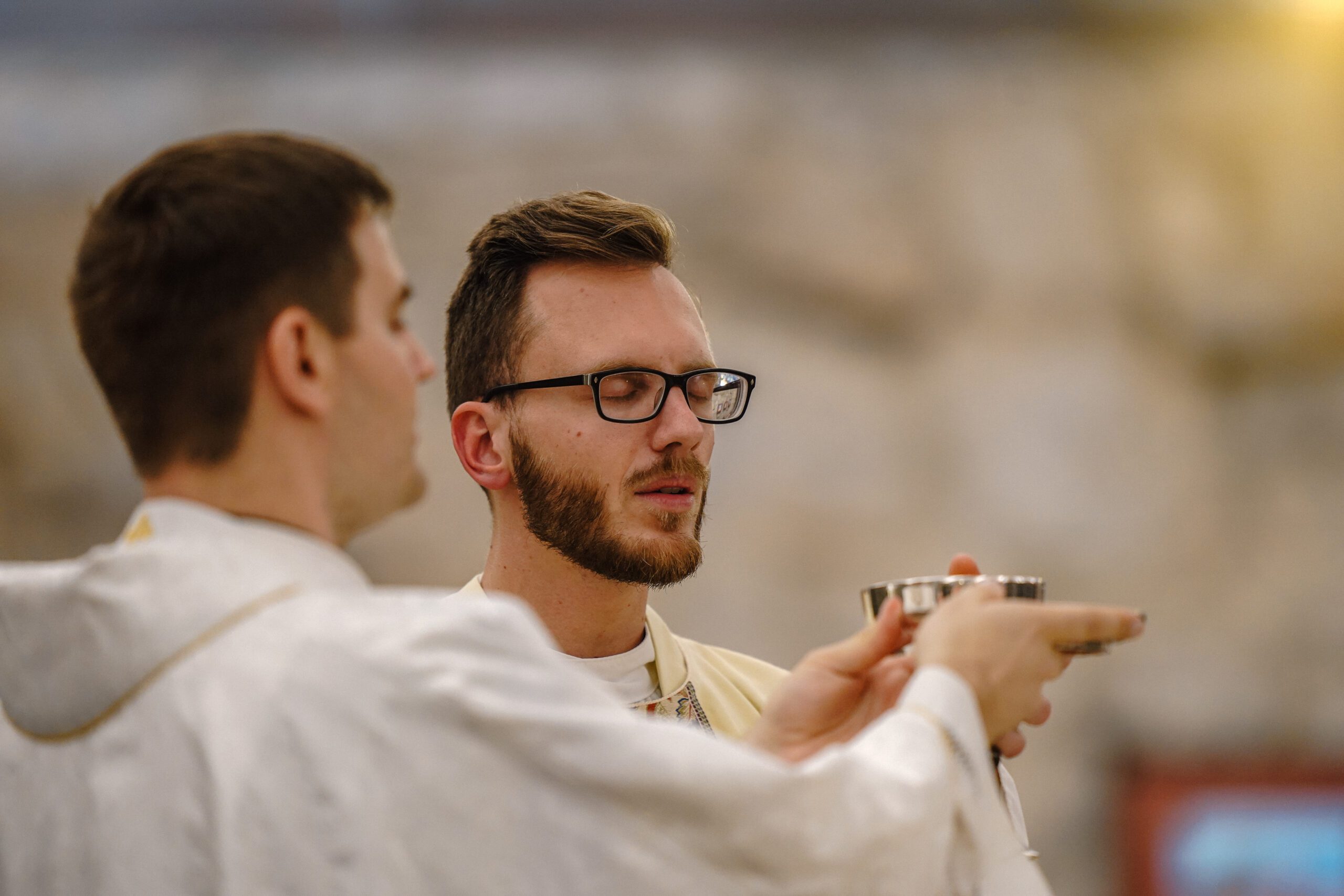
  • Mass - The congregation kneels as the priest lifts the Sacrament, declaring:  "This is the Lamb of God who takes away the sins of the world."  At Communion, each individual bows in front of the Blessed Sacrament before receiving Our Lord under the appearance of bread and wine.

  • Exposition - In some parishes, the Blessed Sacrament is exposed for adoration one day a week.  People sign up for a specific hour or simply drop by whenever convenient for personal prayer before the Blessed Sacrament.


  • Forty Hours Devotion - Forty semi-continuous hours of adoration of the Eucharist, held annually in some parishes.


  • Perpetual Adoration - Continuous exposition of the Blessed Sacrament for the purpose of uninterrupted adoration, twenty-four hours a day, seven days a week.


  • Church Visit - A short visit to a church for the purpose of greeting the Blessed Sacrament reserved in the tabernacle.


  • Benediction - After a period of exposition and adoration, the Blessed Sacrament is used to bless the congregation.  Eucharistic hymns, most often O Salutaris Hostia and Tantum Ergo, are traditionally sung.


History of Perpetual Adoration

Although the Real Presence has been recognized since the time of the apostles, evidence shows perpetual adoration may have begun in the sixth century in the Cathedral of Lugo, Spain.  By the twelfth century, St. Thomas a Becket is known to have prayed for King Henry II before the "majesty of the Body of Christ," and by the sixteenth century the devotion known as forty hours had developed.  In nineteenth-century France, perpetual adoration developed in communities of contemplative nuns.  The devotion eventually spread to parishes throughout the world.


Things to Do During Eucharistic Adoration

Fr. Benedict Groeschel points out in In the Presence of Our Lord:  The History, Theology and Psychology of Eucharistic Devotion that there are "four kinds of prayer most appropriate in the presence of the Eucharist, namely adoration and praise, thanksgiving, repentance and trusting intercession."  Here are suggestions for what to do during private Eucharistic adoration.


1.  Pray the Psalms or the Liturgy of the Hours

Whether you are praising, giving thanks, asking for forgiveness or seeking an answer, you'll find an appropriate psalm.  The ancient prayer of the Church called the Liturgy of the Hours presents an excellent way to pray through the Book of Psalms throughout the year.


2. Recite the "Jesus Prayer"

Say "Lord Jesus, have mercy on me, a sinner", repeatedly as you quiet your heart and mind.


3.  Meditate using Scripture

Choose a passage from the Bible.  read the words and ask God to let the passage speak to you.  Pay special attention to anything that strikes you and ask God what He wishes for you to draw from that message.


4.  Read the life of a saint and pray with him or her

Most holy men and women have had a great devotion to Our Lord in the Eucharist.  Therese of Lisieux, Catherine of Siena, Francis of Assisi, Thomas Aquinas, Peter Julian Eymard, Dorothy Day. Mother Teresa of Calcutta and Baroness Catherine de Hueck are just a few.  Read about them and pray their prayers before the Blessed Sacrament.


5.  Pour out your heart to Christ and adore Him

Speak to Jesus, aware that you are in His presence, and tell Him all that comes to your mind.  Listen for His response.  Pray the prayer that St. Francis instructed his brothers to pray whenever they were before the Blessed Sacrament:  "I adore you, O Christ, present here and in all the churches of the world, for by your holy cross you have redeemed the world."


6.  Ask for forgiveness and intercede for others

Think of those who have hurt you and request a special blessing for them.  Ask God to forgive you for all the times you have neglected or hurt someone else.  Bring before the Blessed Sacrament all those who have asked you to pray for them.  Ask the Lord to address their concerns.


7.  Pray the Rosary

Pope John Paul II reminds us, "...is not the enraptured gaze of Mary as she contemplated the face of the newborn Chris and cradled him in her arms that unparalleled model of love which should inspire us every time we receive Eucharistic communion?"  (The Church and the Eucharist, 55)  Ask Mary to join you as you gaze on Christ in the Eucharist and as you pray the Rosary.


8.  Sit quietly and just "be" in the presence of God

Think of a visit to the Blessed Sacrament as coming to see your best friend.  Sit quietly and enjoy being in each other's company.  Instead of talking to the Lord, try listening to what He wants to tell you.

| Home |