Monday, November 27, 2000
Milestone: External research funding tops $100 million
Institutional strategic plan receives unanimous approval

Registering historic steps
Academic Building to be named for Holmes and Hunter
By Larry B. Dendy
ldendy@uga.edu

The university plans to name the 169-year-old Academic Building in honor of Charlayne Hunter
and the late Hamilton Holmes, who registered for classes in the building when they became the first African Americans to enroll at UGA in 1961.
At their regular November meeting, the University System Board of Regents approved UGA’s request for permission to name the structure the Holmes-Hunter Academic Building.
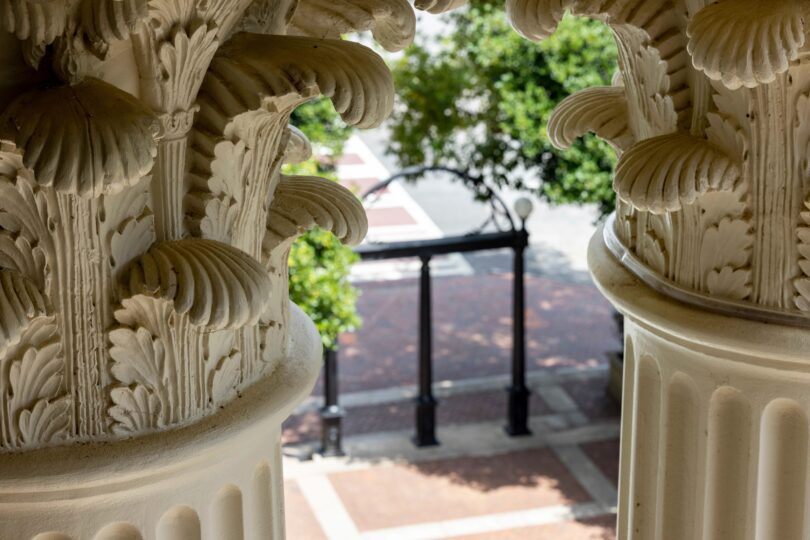
The three-story building, marked by four tall Corinthian columns enclosing an exterior staircase, is the first structure on the west side of UGA’s North Campus, just a few feet from the Arch, which marks the historic entrance to campus near the intersection of Broad Street and College Avenue.
On Jan. 9, 1961, Hunter (now Hunter-Gault) and Holmes walked past the Arch and into the Academic Building where they went to the registrar’s office and registered for classes, thus ending 160 years of racial discrimination at the university.
Hunter and Holmes both graduated two years later and went on to successful careers, Hunter as an internationally known journalist and Holmes as a prominent Atlanta orthopedic surgeon. Holmes died in 1995 in Atlanta following heart bypass surgery.
On Jan. 9, 2001, UGA will hold a public symposium and other events to observe the 40th anniversary of the desegregation. Hunter-Gault will deliver the annual Holmes-Hunter Lecture as part of the symposium that will begin at 9 a.m. in Hodgson Hall.
UGA President Michael F. Adams says naming the Academic Building for Hunter and Holmes permanently commemorates one of the milestones in university history.
“When Charlayne Hunter and Hamilton Holmes walked through the Arch and registered for classes in the Academic Building, the mission and direction of the University of Georgia were forever changed,” Adams says. “Their courageous act paved the way for the University of Georgia to be an educational institution that serves all citizens. Naming this building for them ensures that their personal contributions will never be forgotten.”
After receiving her bachelor’s degree in journalism, Hunter-Gault was a reporter for The New York Times before beginning a long association with PBS’s MacNeil/Lehrer News Hour as a reporter and anchor. She later joined National Public Radio as a correspondent for Africa, before moving last year to the Cable News Network, where she is currently bureau chief in Johannesburg, South Africa. Her numerous awards include two Emmys and two Peabody Awards for her coverage of Africa. Her memoir, In My Place, was published in 1992.
Holmes received a bachelor of science degree from UGA and graduated in 1967 from Emory University School of Medicine, where he was also the first African-American student. In addition to his successful orthopedic practice, he served as associate dean of the Emory School of Medicine and as senior vice president for medical affairs and chairman of the orthopedic unit at Grady Memorial Hospital.
As students, Hunter and Holmes endured racial tension, and in the immediate years following graduation did not have close ties to their alma mater. In time, both renewed their UGA affiliations and became strong friends of the university.
In 1983, Holmes accepted an invitation to become the first African-American member of the board of trustees of the University of Georgia Foundation. He also served with distinction on an alumni committee to plan the university’s bicentennial celebration, held in 1985. Additionally, he worked with the Alumni Society and helped recruit minority students, including his son, Hamilton E. (Chip) Holmes Jr., who graduated in 1990.
Hunter-Gault was UGA’s Commencement speaker in 1988 and delivered the Walter B. Hill Lecture 10 years later. As part of the 40th anniversary celebration in January, she will give the annual Holmes-Hunter Lecture, created as part of UGA’s bicentennial celebration.
The Academic Building in its current configuration dates from 1905. But it was actually created by joining two buildings that were constructed decades earlier. One of the buildings, erected in 1831, housed the university’s small library and several classrooms. Known as the Ivy Building because its red brick exterior was blanketed by ivy, the building had two stories, each measuring 40 by 25 feet.
In 1905, a university engineering professor, Charles N. Strahan, devised a plan to join the two buildings by adding a third story to the Ivy Building and bridging the two structures with a Corinthian portico featuring tall columns and an exposed stairway.
The building still houses the registrar’s office, along with offices for the Honors Program, student financial aid, the student affairs division and the Office of Institutional Research and Planning.

UGA Today ] News Bureau ] Master Calendar ] Columns ] Georgia Magazine ]
UGA Home ] Admissions ] Directories ] Sports ] Alumni ] Weather ]
Search this site ] Search UGA sites ]

Developed by University Communications News Bureau at the University of Georgia.
Beth Roberts: Columns editor, Juliett Dinkins: Columns managing editor,
Janet Beckley: Columns art director.
This site works best with the latest version of
Netscape Navigator 4.0 and Microsoft Internet Explorer 4.0.