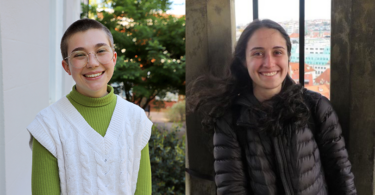
Photo: Richard Hill (left) and Charles Atwood experimented with classroom observations by retired faculty in the chemistry department. Photo by Paul Efland.

Peer Review of Teaching

By Beth Roberts

At the University of Georgia, graduate students--the college professors of the future--have the chance to learn to teach. The Office of Instructional Support and Development offers workshops and training sessions for teaching assistants and laboratory assistants, as do several academic departments. Excellent TAs earn significant and sought-after awards and serve as mentors for beginners. UGA Ph.D.s leave Athens for their first faculty position trained both as researchers and as teachers.

That is not yet the case at every major research institution, although the day is coming. And few current members of UGA's faculty received training in teaching when they themselves were graduate students. Traditionally, college professors learned to teach by watching their own professors over the years of preparing to join their ranks.

While this approach produced a great number of spectacularly good teachers, it also left a good many faculty members wishing they could improve.

In 1994, UGA was invited to participate in a major national project that is intended to develop a variety of such options for faculty. "From Idea to Prototype: The Peer Review of Teaching" was organized by the American Association for Higher Education to experiment with peer review as a way of improving teaching.

Additional information about both peer review and this project is available in the Office of Instructional Support and Development.
Participating Institutions: AAHE Peer Review Project
Alverno College
Georgetown University
Indiana University-Purdue University at Indianapolis
Kent State University
Northwestern University
Stanford University
Syracuse University
Temple University
University of California, Santa Cruz
University of Georgia
University of Michigan
University of Nebraska
University of North Carolina at Charlotte
University of Wisconsin
University of Wyoming
Xavier (La.) University

Ron Simpson of the Institute for Higher Education, who is coordinating the project at UGA, says 'peer review' may not be the most descriptive term.

"Some people prefer the term 'peer collaboration,' " he says. "These ideas came to be known as peer review in the context of Ernest Boyer's 1990 book Scholarship Reconsidered. Boyer argued that teaching was an integral part of scholarship, and peer review has traditionally been the way in which scholarship is judged in the academy."

The contrast between how scholars share research and how they approach teaching is central to the project, according to William F. Prokasy, vice president for academic affairs and director of the peer-review project here. "It would be nice to see teaching talked about in much the same way we talk about our disciplinary inquiries," he says. "We need to move teaching to the realm of public discourse."


'Formative vs. summative'
Those involved in peer review distinguish first between purposes, between "formative" and "summative" peer-review projects. At UGA, most programs have been formative, intended to help faculty members improve their teaching, rather than summative, intended to evaluate someone's success in teaching. The two approaches obviously overlap extensively, which is why the term "peer review" can be confusing.

The teaching circles instituted by the history department offer a direct approach to encouraging teachers to talk about teaching--techniques, problems, ideas, difficulties. As Simpson says, "Teaching is difficult to learn alone and learning from more experienced colleagues is a time-honored tradition."

A syllabus exchange is a similar technique for getting started at peer review within a department. George Francisco, associate dean in the College of Pharmacy, finds this an effective way of focusing discussion--on course design, content, goals.

"These are things that are never included in a promotion dossier," he notes, even though faculty members put a great deal of effort into them.


Teamwork
Peter Shedd and Jere Morehead, both of the department of insurance, legal studies, real estate and management science in the Terry College of Business, have worked together in the course of this project to interview each other's students as a way of analyzing how well students are learning.

The chemistry department has experimented with mentoring as part of the peer-review project. Many departments at UGA already arrange for or at least encourage experienced faculty to serve as mentors to new members of the department, guiding them in their research responsibilities. Expanding this guidance function to teaching gives younger faculty the chance to profit from the experience of others.

Charles Atwood and Richard Hill developed this project within the chemistry department, using retired faculty members as mentors for younger faculty. The mentor visits lectures and labs, meeting with the faculty member both before and after visits. Both emphasize that this program has been voluntary and formative, that is, focused on improving teaching and learning.

"You go about it differently depending on what the department wants to get out of it," Hill says. "Some institutions use classroom visitation for faculty evaluation, and they have to have very formal procedures."

UGA Peer Review Project Team
Director: William F. Prokasy, vice president for academic affairs
Coordinator: Ronald D. Simpson, Institute for Higher Education
Agricultural and Applied Economics:Josef M. Broder, Christopher S. McIntosh, Michael E. Wetzstein
Anatomy and Radiology: Paul T. Purinton
Chemistry: Charles H. Atwood, Richard K. Hill, Kenneth W. Whitten
Educational Psychology: Joseph M. Wisenbaker
History: Thomas W. Ganschow, William F. Holmes, John C. Inscoe, Laura Anne Mason, Eve M. Troutt Powell
Insurance, Legal Studies, Real Estate, Management Science: Jere W. Morehead, Peter J. Shedd; Pharmacy: George E. Francisco Jr.
Small Animal Medicine: Dennis N. Aron, Craig E. Greene, Jean Stiles

Using retired faculty members as visitors eliminates some of the fear faculty members might feel at the prospect of classroom visits, since retired faculty are not involved in promotion decisions. Hill, who is retired from the chemistry department, is a former winner of the university's Meigs Award for Excellence in Teaching and thus a knowledgeable observer of the teaching of chemistry.

But classroom visits, thoroughly planned, can in fact be useful in tenure, promotion and post-tenure review evaluations, rather than relying exclusively on student evaluations.

"Faculty can evaluate things that students cannot," says Atwood. He is convinced that evaluations of teaching would be more useful--to the department, the discipline, the institution and the faculty member--if faculty were involved in the process.

In the course of this project, Hill and Atwood have developed recommendations for departments or colleges that want to experiment with such evaluations. They believe a committee of faculty peers might play an important role in such evaluations in the future.


The role of student evaluations
Josef Broder of the department of agricultural and applied economics, another Meigs winner, looked explicitly at student evaluations as part of the peer-review project at UGA, and he too decided that student evaluations should not be the sole means of evaluating teaching.

His study covered every student evaluation form used in his discipline in the United States and Canada, and he concluded, among other points, that most such forms could be much shorter and better focused on student learning.

Most important, he says, "student evaluations should be made an integral part of the peer collaboration process--because only peers can evaluate teaching."

And that truism applies whether the evaluation has a formative or a summative goal--whether the purpose of the evaluation is to help the teacher improve and the students learn, or whether it is intended to be included in a promotion or tenure review.

The crucial point, Ron Simpson says, is clearly distinguishing between these two purposes and designing procedures that fit the purpose at hand. Further, he suggests, pre-tenure and post-tenure reviews must be handled differently, and some consideration must be given in advance to workload questions.

"It might be best, for example, to undertake a deeper analysis of a single course every three years for senior faculty," he says, in order to be able to conduct it thoroughly and usefully. "And if we are evaluating for the purpose of improving, then we need to have procedures in place that can provide help to those who may need it."

He adds that the various approaches to peer review during this project have demonstrated the importance of "keeping the emphasis on learning, on producing an effective learning environment, and not on the personal style of the teacher."

Ultimately, he believes this project is offering some necessary guidance to "making teaching a public property. You can't place a value on an anonymous activity, and excellent teaching will only be genuinely recognized and rewarded when it becomes community property, as public as research."