B. A. NUMMER1, E. L. Andress1, J. A. Harrison1, M. A. Harrison2, and W. L. Kerr2. (1) Dept. Foods and Nutrition Extension, University of Georgia, 208 Hoke Smith Annex, Athens, GA 30602, (2) Dept. Food Science and Technology, University of Georgia.
Paper 46B-5. Presented at the Institute of Food Technologists Annual Meeting Anaheim, CA, June 17, 2002.
Home food preservation remains an important and popular cultural activity. The safety of these products and processes remains the number one concern. The National Center for Home Food Preservation (NCHFP) was created to help meet the needs of both Extension agents and consumers for science-based information. As part of the NCHFP mission a web site was created to locate, review, and disseminate research-based home food preservation information. The web site, www.homefoodpreservation.com, offers publications from U.S.D.A. guides and bulletins, the University of Georgia, literature reviews of current topics, links to other state Cooperative Extension homepages, seasonal tips, multimedia demonstrations, FAQs, contact lists and a variety of other resources. Initial feedback from a sampling of Cooperative Extension agents has been favorable. Experienced home preservers have also given favorable reviews, while inexperienced home food preservers commented that they are a bit overwhelmed. The initial comments and popularity of the site indicates that it is meeting its objectives of providing resources to Cooperative Extension professionals and increasing public awareness of science-based safe home food preservation techniques.
According to the latest Nielsen Media Research survey there are now 92 million Americans over the age of sixteen on the Internet (CommerceNet, 1999). This is almost half of the population. This incredible growth in access has made the Internet an excellent source for educational and reference materials. The Internet is fast becoming an important tool for food safety specialists, allowing for rapid location of specific information. One food safety resource, the National Food Safety Database, had over 10,000 requests per day, over 145,000 distinct users, and an international audience of 85 countries (Tamplin, 1998). The need for access to food safety information will no doubt markedly increase in the coming years, with new food safety regulations, media attention, and advances in Internet technologies.
Web site. The web site was constructed by the Web Instructional Development group, a part of the University of Georgia Center for Continuing Education, Athens, GA and members of the National Center for Home Food Preservation management team.
Design Analysis. Site design analysis was performed using criteria developed by authors at Yale and Dartmouth Universities (Lynch and Horton, 1997).
Assessment. An assessment of objectives was obtained from a small survey group of 37 educators and consumers and from direct feedback. Web site users were encouraged to send direct feedback and a 15-question survey was created (Exhibit 1) to solicit users feedback.
User-centered design. The NCHFP web site users are both consumers and professionals. Consumers range from first-time home food preservers to highly experienced food preservers. Professionals include Cooperative Extension professionals, teachers, researchers, journalists, and publishers. The survey group consisted of 17 Cooperative Extension agents, 17 consumers, and 3 others.
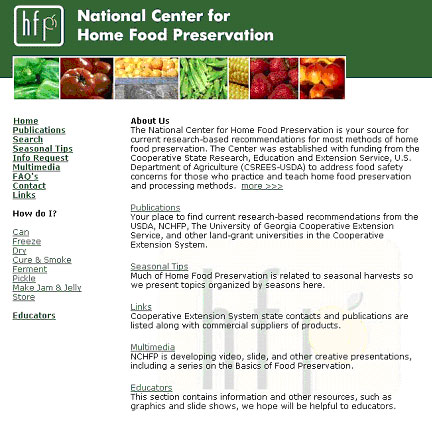
The front page. As an informational site, the front page (Figure 1) establishes an overall visual design with the NCHFP logo. It identifies and gives a brief explanation of the purpose of the site, and provides a site overview by presenting links to its major sections. This page answers the questions, Where am I? What is it like here? What do these people do? What kind of stuff will I find? As a reference site visitors are able to tell at a glance if the information they are seeking is inside. Ninety-two percent felt the home page was “very useful” in its current form.
Figure 1. National Center for Home Food Preservation Front Page
Objectives. Clear and simple goals are key to successful web sites (Table 1).
Authors. It is critical the audience understand who the NCHFP is and the USDA message of using only “science-based” information. The survey group was asked “On your first visit to the web site was it clear whom the NCHFP was?” Eighty-one percent said “yes”, 16% said “yes, but I had to look some” and 3% said “no, I found that information, but it was not completely clear”. A second question asked, “On your first visit to the web site was it clear what “science-based” guidelines and recommendations on Home Food Preservation are?” Sixty-eight percent responded “yes”, 22% responded “yes, but I had to look some”, 5% responded, “no, I found that information, but it was not completely clear, and 5% responded they “did not find that information”.
Navigation. An easy hierarchal structure amenable to both the experienced web surfer and the novice was desired. Eighty-six percent of our survey group responded that the web site was “well categorized and easy to follow”; while 14% responded that it “could be figured out with some effort”.
Pages. Individual pages were created to be simple and consistent. The survey group responded that the placement of buttons and links, colors used, and overall page layouts were “well done and appealing” (76%), “pretty good” (19%), and “nothing special” (3%). The survey group also responded that the graphic appeal of our site was “professionally done and contemporary in appeal” (73%), “pretty good” (24%), and “nothing special” (3%).
Bandwidth. Sixty-five percent of the respondents had a telephone modem or similar slow Internet connection (including all consumer respondents), while 38% reported having a cable modem or similar faster Internet connection. Keeping bandwidth usage to a minimum was critical in serving these users. Some of the Adobe Acrobat™ PDF and Real Media™ files are large for slower connections (Table 2). Some respondents indicated the site was too slow (1 reply) or they had difficulty with large multimedia files (6 replies). Providing alternate sources (e.g. CD-rom, print, downloadable files) for heavy bandwidth files would help alleviate some of these problems.
Interactivity and Search. As both an informational and reference web site we sought to provide quick access to relevant information. When information cannot be located in a menu the search section can guide a user through internal and external search resources to find information. There is also an “Info request” form. Over 85% of the survey group indicated they found the search features “very useful”. Written feedback from novice computer users indicated they had difficulties understanding and using these search functions. Thus, redesigning the “search” topic to make it a logical and simplistic tool more amenable to both novice and expert computer users will be considered.
Multimedia. Some topics benefit by visual enhancement. We created digital video, audio, and animation. This section was the most troublesome of the web site content where 51% of our survey group felt the multimedia section was less than “very useful”. Survey group participants had problems with slow connections, downloading required software, and in getting the multimedia software to run. To address these problems additional means of delivering these files are being considered (e.g. CD-rom). The results may have also been influenced by the minimal content of this section. More content is scheduled to be added.
Change in knowledge and behaviors. Initial comments and popularity of the site indicate that it is meeting its objectives of providing resources to the Cooperative Extension System and increasing public awareness of science-based safe home food preservation techniques. Overall 34 of 37 surveyed felt that the web site would be a positive influence to serve the home food preservation needs of educators. One felt there would be “no influence” due to the lack of usable materials and two consumers had “no opinion”. All 37 respondents felt the web site would be a positive influence on consumers. Seventy-one percent of the survey group felt the “more information on the web site the better”. Two respondents, both were novice food preservers, felt the information “seemed like too much” or was “far too much”. This may suggest the need for “beginner friendly” resources for an introduction to the web site and its contents.
Suggestions. Written suggestions for materials to add included: a site map, why preserve foods for beginners, what your Extension office can do for you, what’s new page for the site, Latin foods, low sugar recipes, links to master gardeners, metric conversions, links for international visitors, a food pH guide, hazardous recipe listing, food safety of preserved gifts, new fruits and vegetable varieties, as well as numerous requests for narrow information topics (e.g. lemon curd, and pomegranate). Additional materials are currently being created and reviewed for placement on the web site. A full-time Webmaster has been hired for site management, further design and building of the site, improvement of access in areas identified by this research, and ongoing evaluation of the site.
Lynch, P. and S. Horton, 1997. Web Style Guide. Yale University. Available at: http://info.med.yale.edu/caim/manual/ Accessed 17 May 2002.
Access Board. 2001. Web-based Intranet and Internet Information and Applications. Washington DC. Available at: http://www.access-board.gov/sec508/guide/1194.22.htm. Accessed 1 Jun 2002.
CommerceNet. 1999. Industry Statistics. Available at: http://www.commerce.net/research/stats/wwwpop.html. Accessed 5 Jun 2002.
Tamplin, M.L. 1998. National Food Safety Database. Project No. 98-EFSQ-1-0330. The Food Safety and Quality National Initiative Abstracts. Washington, DC.: U.S. Department of Agriculture. Available at: http://www.reeusda.gov/pas/programs/foodsafety/98abs.htm. Accessed 10 Jun 2002.
Exhibit 1. Survey for Center Web Site
The National Center for Home Food Preservation
1. Describe yourself
45% [17] Cooperative Extension Agent
[ ] State Cooperative Extension Specialist or Program Assistant
3% [ 1] Other University Faculty or Staff
[ ] Extension Volunteer / Master Food Preserver
45% [17] Consumer (Home Food Preserver)
5% [ 2] Other ____________________ e.g. Food Writer, Author, etc.
Total 37
2. Rate your experience level in Home Food Preservation
43% [16] Experienced
24% [ 9] Average Experience
24% [ 9] Some Experience
8% [ 3] Little experience
[ ] No experience
Total 37
3. What type of Internet connection are you using?
14% [ 5] Below 33.6 Kbps telephone modem or I don’t know numbers,
but it is a slow connection.
49% [18] 56Kbps telephone modem.
3% [ 1] Cable modem or I don’t know speeds, but it is a fast
connection.
35% [13] University or other high speed network connection
Total 37
4. On your first visit to the web site was it clear whom the National Center for Home Food Preservation was?
81% [30] Yes
16% [ 6] Yes, but I had to look some
3% [ 1] No, I found that information, but it was not completely clear
[ ] No, I had trouble finding that information
Total 37
5. On your first visit to the web site was it clear what “science-based” guidelines and recommendations on Home Food Preservation are?
68% [25] Yes
22% [ 8] Yes, but I had to look some
5% [ 2] No, I found that information, but it was not completely clear
5% [ 2] No, I had trouble finding that information
Total 37
6. In your opinion, the amount of information on our web site is:
3% [ 1] Far too much
3% [ 1] Seems like too much
23% [ 8] Appropriate
71% [25] The more the better
Total 35 No reply 2
7. In your opinion, the organization of our web site is:
86% [31] Categorized and easy to follow
14% [ 5] Could be figured out with some effort
[ ] Confusing and difficult to follow
Total 36 No reply 1
8. In your opinion, the graphic appeal of our home page is:
73% [27] Professionally done and contemporary in appeal
24% [ 9] Pretty good
3% [ 1] Nothing special
Total 37
9. In your opinion, the placement of buttons and links, colors used, and overall page layouts are:
76% [28] Well-done and appealing
19% [ 7] Pretty good
3% [ 1] Nothing special
Total 37
10. Please visit and rate the section topics of our web site for usefulness (please do not rate the topics on content - more content will be added to sections as we continue our project). Place a check mark in the box of your choice.
| Information is: | Very Useful | Somewhat useful | Not Useful |
|---|---|---|---|
| Home Page | 34 (92%) | 3 (8%) | |
| Publications | 31 (84%) | 6 (16%) | |
| Search Our Site | 30 (88%) | 4 (12%) | |
| Search CES Sites | 30 (86%) | 5 (14%) | |
| Seasonal Tips | 19 (56%) | 11 (33%) | 3 (9%) |
| Info Request | 22 (71%) | 7 (26%) | 2 (6%) |
| Multimedia | 17 (49%) | 13 (37%) | 5 (14%) |
| FAQs | 29 (85%) | 4 (12%) | 1 (3%) |
| Links | 32 (94%) | 2 (6%) | |
| “How do I?” | 36 (100%) |
11. Please write section topic ideas that are not included in our web site that you feel would be useful (e.g. a site map).
Site Map, Why preserve foods for beginners, what your extension office can do for you, what’s new page for the site, latin foods, low sugar pages, links to master gardeners, metric conversions,
12. If you found useful information, was it available in a computer format that was accessible to you? (e.g. MS PowerPoint PPT, Adobe Acrobat PDF, Macromedia Flash, and Real Media).
81% [30] Yes
19% [ 7] Yes, but I had to or would need to download software to
make the information accessible.
[ ] No
Total 37
13. In your opinion, will this web site serve educators in the area of home food preservation?
92% [34] Positive influence
3% [ 1] No influence (responded not enough materials yet for educ.)
[ ] Negative influence
6% [ 2] No opinion
Total 37
14. In your opinion, will this web site serve consumers in the area of home food preservation?
100% [37] Positive influence
[ ] No influence
[ ] Negative influence
Total 37
15. What sources of frustration did you encounter on the web site? Please elaborate. You may also write general comments here.
Site was too slow (2 replies), trouble with Real Media/multimedia (6 replies), overwhelming information overload.
Reviewed by Elaine D’Sa, Ph.D. and Elizabeth Andress, Ph.D., National Center for Home Food Preservation.
This material is based upon work supported by the Cooperative State Research, Education, and Extension Service, U.S. Department of Agriculture, under Agreement No. 00-51110-9762.
Document Use:
Permission is granted to reproduce these materials in whole or in part for educational purposes only (not for profit beyond the cost of reproduction) provided the authors and the University of Georgia receive acknowledgment and this notice is included:
Reprinted with permission of the University of Georgia. Nummer, B.A., E. L. Andress, J. A. Harrison, M. A. Harrison, and W. L. Kerr. 2002. Disseminating science-based home food preservation information on the Internet. Athens, GA: The University of Georgia, Cooperative Extension Service
References to commercials products, services, and information is made with the understanding that no discrimination is intended and no endorsement by the University of Georgia, U.S. Department of Agriculture and supporting organizations is implied. This information is provided for the educational information and convenience of the reader.
The University of Georgia and Ft. Valley State University, the U.S. Department of Agriculture and counties of the state cooperating. The Cooperative Extension Service, the University of Georgia College of Agricultural and Environmental Sciences offers educational programs, assistance and materials to all people without regard to race, color, national origin, age, sex or disability. An Equal Opportunity Employer/Affirmative Action Organization Committed to a Diverse Work Force.
Contact: