September 11, 2001 The University of Georgia Responds
The Forums The Russell Symposium In the News Books & Resources Photo / Video Gallery Your Thoughts
The Forums

• Sept.17, 2001: Forum - "Aftershock: coming to grips with terrorism in America"
• Sept. 24, 2001: Center for Humanities and the Arts Forum - "Humanistic values in a time of crisis"
• Oct.
.. 8, 2001: International Forum: Understanding Terrorism - "Afghani, Indian and Pakistani Perspectives"
• Oct. 15, 2001: Forum - "International Students Speak about the War on Terrorism."
• Nov. 14, 2001: Cynthia Tucker, the editorial page editor of the Atlanta Journal-Constitution, delivers the 24th Annual Ralph McGill Lecture - "
The role of the press in the post-September 11 world"

Gary Bertsch

Gary Bertsch
Director of the Center for International Trade and Security
x

Alan Godlas

Alan Godlas
Department of Religion, associate professor of religion

Loch Johnson

Loch Johnson
Regents Professor
of Political Science

Han S. Park

Han S. Park
Director of GLOBIS/Professor


Scott Jones

Scott Jones
Senior Research Associate
at the Center for International Trade and Security
specializing in the European Union (EU), Ukrainian export control policy, and security issues in Ukraine, the Caucasus, and Central Asia.
x
x
Monday, Sept. 17, 2001:

"AFTERSHOCK: COMING TO GRIPS WITH TERRORISM IN AMERICA":
Hosted by UGA's Department of Political Science and Center for International Trade and Security
The full presentation can be seen in a Webcast on the New Media Institute Web site


Webcast
RealPlayer plug-in
Photo Gallery
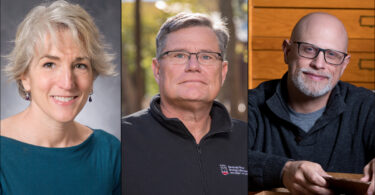
A panel discussion called “Aftershock: Coming to Grips with Terrorism in America” took place in the Chapel at noon Sept. 17. The panelists, all UGA faculty members, made brief presentations and answered audience questions dealing with the Sept. 11 terrorist attacks in New York and Washington, D.C. They emphasized the importance of focusing the American response not only on the apprehension of those who undertook the attacks, but also on preventing future terrorism by eliminating its causes. Participants were Jeffrey D. Berejikian and Loch K. Johnson of the political science department, Alan Godlas of the religion department, Han S. Park and Carlo Pelanda of the Center for the Study of Global Issues, and Scott A. Jones of the Center for International Trade and Security. Gary K. Bertsch, CITS director, was moderator.


Gary K. Bertsch
CITS director

This is a time, it seems to me, for remembering, for reflecting, for trying to understand, and for beginning to act. Events in history of this magnitude provide a point for us to do new things, to address the kind of challenges that confront us. A noted former British prime minister once commented that the university should be a place of light, and liberty, and learning. All of us are asking what we can do, what we should do, to address some of the problems, some of the challenges that we’re all a part of. I would like to say to all of you that there’s much that we can do, you and I. I’m confident that we can all learn from this experience, that through meetings like this, through our private discussions, through our thinking and reflecting, we will learn how to deal with these present events and those that we will confront in the future. We can shed light on these events. And I believe that by working together we can address these challenges and we can together build a safer and a better world. I stand before you today to say that much good can come of this tragic event. I’m confident that we will become stronger, we will deepen our understanding, we will begin to address the root causes for such actions, and that we will begin to build a better world in the 21st century.

This is, I believe, the first event, the first program, for our new School of Public and International Affairs that we’re beginning this fall. And I’m pleased to have colleagues from the department of political science, from the Center for International Trade and Security, and from the department of religion to share their insights. I think that they can help us shed light on these events, they can help us learn from these events. But we also welcome all of you to join us in this common endeavor. . . .

Jeffrey D. Berejikian
Professor of political science

Good afternoon. Well, there is a lot to talk about.

Given the title of our forum, I guess I’d like to use my time to open a discussion about some of the broader ethical issues related to the bombing.

What I mean is this: Many of the responses being discussed in the press, in my classrooms, and I suspect across the country raise important moral questions. For example:
-Do we want to reauthorize political assassination as a tool of American foreign policy?
- Do we want to allow the CIA to recruit, hire and reward human rights violators, because they possess useful information?
- Do we want to accept significant so called ‘collateral damage’ - an antiseptic term or killing civilians?
- Should we target for death individuals who we believe may in the future act violently, but who as of yet have not done so?

That is, any sustained response to the bombing forces us to confront difficult questions, the answers to which ought to be guided by good moral reasoning. Unfortunately, such considerations are sometimes absent in some of the statements offered by our national leadership.

- I note for example, Zell Miller’s fist impulse to ‘bomb the hell out of them’ without first discussing who ‘they’ are.
- Or William Bennet’s comment that we might have to ‘take this war to China’
- Or Jean Kirkpatrick’s characterization that this amounts to a ‘Culture War’ between Western and Muslim worlds

Given this, It seems then that the task of moral discourse is left to us. And this is perhaps as it should be in a democracy. As a place to begin, I would offer two thoughts: 1st Defining this conflict as a "war"legitimates actions that are morally dubious, given the actual nature of terrorism; 2nd Crafting a moral consensus is a necessary condition for success in this struggle, whatever your definition of success is.

As to the first point, despite the widespread use of the term I think we should pause, step back, and ask ourselves ‘Is the struggle to protect US citizens from terrorism a ‘war’ in the traditional sense of the term? One could argue that its not. You could, for example, argue that this was instead an act of mass murder in the service of political goals. Not an act of war. Importantly, You would not be alone in this view. No less than General Wesley Clark, former commander for NATO, has urged our nation to think about this as a criminal act, not an attempt to conquer the United States Government.

Why is this distinction important? Well, in a good old fashioned war, we tolerate many things, among them, for example, sometimes large numbers of civilian casualties. And one common argument about the World Trade Center attack is that in this war, like all others, we may have to kill many innocents. This is justified because innocent deaths are an unfortunate but inevitable consequence of war.

By contrast, I ask you to consider the fact that, as a society, we have decided to be quite intolerant of collateral damage when pursing murders. We want murders punished, yes, but we don’t attack a neighborhood killing the crossing guard, bus driver, or the soccer mom, in order to get the bad guy. Nobody, I think, would support anything a ridiculous as this, but when we use terms like ‘carpet bombing’ or ‘massive retaliation’ this is essentially what we are talking about.

The point here is that the way in which we define the conflict has fundamental implications for the kinds of moral action we can take. If we are to use our established moral guideposts as the foundation for our response to the World Trade Center bombing, then the definitions we create about the nature of the conflict are crucial to what we then would consider a moral and justifiable response. I ask you simply to consider this, in your deliberations about this tragedy.

As to the second assertion, that some kind of moral consensus is necessary for success, I think our own past experience in this country is an important guide. History has clearly demonstrated that the mobilization of society – especially an open society – is easiest when such a moral consensus exists. So, there are then good tactical reasons to first craft moral guideposts for this nation’s conduct. But there is also, of course, a principled argument to be made.

We could, I suppose, in the extreme decide as a nation to simply adopt the tactics and strategies of terrorists, and justify this by arguing that it’s the only way to fight and win the war. I think that this would be an unsustainable position in the long run. It blurs the distinction between us and them: between civilized society and mass murders. Once that distinction is lost, there really is no reason to fight because we will have simply abandoned the high principles we are supposed to be defending.

Now, ultimately all of this is debatable. And this is really the point, and its why I would urge all of you to bring you own moral sensibilities to bear in an explicit discussion with your fellow citizens about the set of moral cornerstones that should guide us in what will be a long, and possibly unremitting campaign against those who would use violence rather than discourse to resolve disputes.

And with that, I thank you, both for your attention and for coming out in such numbers. It's a wonderful thing to see.

Alan Godlas
Department of Religion, associate professor of religion

I am an associate professor of religion here at UGA, specializing in Islamic Studies and Arabic ( http://www.uga.edu/islam ), and I am also a member of the steering committee for the study of Islam section of the American Academy of Religion. This section represents scholars from every major college and university in the country, and the American Academy of Religion has over 8,000 members—it is the largest organization for the scholarly study of religion. In the light of recent terrorist attacks, we, the members of the study of Islam section of the American Academy of Religion, issued a statement that today will be issued to the press, and I will first cite a few excerpts from that statement. I hope that it will shed a little light on Islam, Muslims, and their differences with terrorists.

"There are now some 8 million Muslims in the United States and mosques are to be found in every major city. The overwhelming majority are peace-loving human beings who share the shock and despair of all Americans [regarding Tuesday’s terrorist attacks]…. American Muslims are good neighbors, devoted to their families and to following God’s commands to do good works…. They know that terrorist acts in the name of Islam are a perversion of their most sacred beliefs, and that the actions of a few should not characterize the whole. With over a billion adherents, Islam is the second-largest religion in the world after Christianity. Like Christians and Jews, Muslims believe in one God, who sent His prophets into the world (as the Qur’an states) ‘to command the good and forbid the evil.’ Jesus is revered in the Qu’ran, the sacred scripture of Islam, as are Abraham, Moses and the Virgin Mary. According to Muslims, the Qu’ran was given by God to the prophet Muhammad some 600 years after Jesus’s birth. It was written in Arabic, and Arabic is still the language of Islam."

"But only 20 percent of Muslims are Arabs, and about 50 percent of Arab-Americans are Christian. Most Muslims are on the Indian subcontinent, Southeast Asia or Africa. [The truth about Islam is often far from what Americans might think. For example,] although many Muslims might differ over Israeli policy, Muslims do not hate Jews. Rather Muslims honor Christians and Jews as fellow recipients of [what the Qu’ran refers to as] ‘the book,’ namely God’s revelation to all humankind. In fact, the Qu’ran commands all Muslims, ‘if they incline toward peace, then you should too.’ [In addition,] suicide is utterly forbidden in Islam, and war must be declared by the state, not by individuals."

"These injunctions explain statements by governments [such as those] of Syria, Saudi Arabia and Libya denouncing Tuesday’s attacks. [Even] radical groups like Hamas and the Taliban have denounced [them], along with the Palestinian leadership. Such political statements must be taken seriously, as they are backed up by all major religious authorities [in Islam], from the rector of Al-Azhar University [in Egypt] to the Grand Mufti of Saudi Arabia, who forbid suicide missions, especially attacks against civilians. Just this past Friday, Sheikh Mohammed al-Tantawi of Al-Azhar of Islam, the highest institution in Sunni Islam, denounced the attack on the World Trade Center and the Pentagon. In his weekly sermon to thousands of worshippers in Cairo, he said, ‘Attacking innocent people is not courageous. It … will be punished on the Day of Judgment.’ Likewise, President Mohammad Khatami of Iran in an official statement said: ‘On behalf of the Iranian government and the nation, I condemn the hijacking attempts and terrorist attacks on public centers in American cities, [attacks] which have killed a large number of innocent people.’ "

Finally, concluding our steering committee statement, "Just as most [Americans] would regard bombers of abortion clinics to be outside the pale of Christianity, so the actions of these terrorists should not be accepted as representing Islam in any way."

Now it should be obvious, based on these statements of the largest body of scholars of Islam in American universities, that acts of terrorism such as those which occurred on Tuesday are not permitted in Islam. So since Islam is not a cause of this terrorism, what are its causes? Two main general causes I can point to right now. One, is that a cause of terrorism is that there has been a movement in the modern period among a sizeable number of Muslims away from the flexibility and spiritual and psychological richness found in traditional Islam toward an Islam that emphasizes inflexibility and the need for political power. This shift has deprived many Muslims of the psychological depth that is necessary to call upon when one is consistently confronted with suffering and unable to use legitimate political means to end it. Thus after having to endure decades of oppression and years of living without rights that Americans take for granted, a few individuals opt for terrorism. Hence the term fundamentalist is not an appropriate term for these terrorists. A better term is militant Muslim extremists. One reason for this is that many scholars regard these extremists not as fundamentalists but as modernists, who have often been influenced by the Marxist ideology of class struggle and the necessity for violent change.

A second and related cause of terrorism consists of the various forms of injustice and oppression in the Arabic Muslim world—oppression which in some cases the United States supports. To clarify this, I must summarize the words of Ramadan Abdallah [Shallah], now the head of the Palestinian Islamic Jihad, who spoke here at a conference organized by the Center for Humanities in 1995, before anyone knew that he was a member of a terrorist organization, before he became the head of a terrorist organization. When he spoke here, he pointed to a number of causes of terrorism, which are essentially four forms of injustice that deeply affect the Muslim world. One form of injustice that he pointed to was the double standard of the U.S. vis-a-vis democracy in the global village. We do not, in truth, participate in an international democracy. This is related to a second injustice, American support of the pseudo-secular rule of dictators in the Muslim world, dictators who rule with a secularism devoid of the freedoms we in the West associate with secularism, a secularism used by rulers to keep themselves in power and to suppress any dissent. A third injustice Abdallah mentioned was one highlighted by French economist Michel Albert in his objection to American capitalism—namely that it needs to fight any threat that might minimize its capital. And the fourth injustice expressed by Abdallah is that of the Palestinians being denied a state and the right of self-determination.

With regards to a solution to the problem of terrorism, the members of the steering committee of the Islam section of the AAR assert that education is the solution to the cycles of violence. Some Muslim groups are attempting to educate Muslims by reviving the knowledge of the spiritual and psychological wealth of traditional Islam; and in this way, they are dealing with the first cause of terrorism that I mentioned, the spiritual and psychological impoverishment of modern political Islam. But all Americans can do their part vis a vis the second cause of terrorism, by becoming educated about the conditions of Muslims overseas. While Americans can take courses and read articles and books about the lives of such Muslims, another way to become educated is by talking with Muslims from abroad and inviting them to tell their stories. From them we might learn about their poverty or about the oppressive conditions that they have left behind, and in this manner we might (in the words of the steering committee) "learn ways we can help alleviate the social and political diseases that [can] cause disaffected young men to see Muslim extremists as leaders."

In conclusion, the meaning of Islam, as Professor Sayyed Hossein Nasr points out, is the surrender to God that in each Muslim who surrenders produces peace, the word for which in Arabic is salaam; and so we must keep in mind that the root and product of Islam, if lived sincerely, is peace.

Loch K. Johnson
Department of Political Science

September 11th is a day forever burned into our memories, and those innocent Americans who perished will forever have a place in our hearts. We feel much sadness and anger. Understandably so; I doubt we will ever be quite the same again. But we Americans are strong and resilient. Among our forebears are Washington, Jackson, Lee, Grant, Eisenhower, and Patton. We know how to fight. Our enemies have made a grievous error in underestimating our resolve. As Churchill once observed, America is like a great boiler; when you light a fire beneath us we give off enormous energy. That energy must now be constructively directed; we cannot let our anger turn to rage, striking out blindly and killing innocentsójust as those monsters did in New York last Tuesday.

We must remember that our enemy is not the people of Muslim faith, but rather a loose alliance of extremists whose goal is to destroy the modern world, whose values they view as anathema to the medieval form of society they prefer. With the help of allies, our military must excise this cancer of extremism without plunging the United States into a war against mass populations with whom we have no quarrel. We must be careful; the use of violence abroad, if it leads to the killing ofinnocents, can galvanize all of the Islamic states against us. That would be a great misfortune. We must find out exactly who and where the suspects are, then apprehend them by way of narrow, pinpointed operations. And if the murderers in these ghost-like terrorist cells resist arrest, then by heaven we'll make true ghosts of them!

Military force, though, is only one of many responses that will be necessary. Our government must have better intelligence about terrorists. This means focusing more on the placement of human agents in places like the Middle East that we tended to ignore during the Cold War; it means recruiting into the U.S. government smart people who speak uncommon languages and understand the cultures of remote regions. We must be more sensitive as well to the uses of America's economic might. We live in relative luxury, while most countries endure numbing poverty; this breeds resentment. A coffee bean grower in the developing world earns $7,000 a year, while Starbucks makes $750,000 off those same coffee beans. Nike pays $1 a day in foreign sweatshop, then reaps billions of dollars in profits. We are rightfully proud of our free enterprise system, the great engine of the world's economy, but we must take steps to close the horrific gap between the rich and the poor on this globe or we will continue to be a target of the angry and dispossessed. Certainly our foreign aid program has been pitiful: we duck our U.N. dues and shell out less per U.S. citizen each year than we spend for pet supplies and flowers. Perhaps instead of $300 rebates and quixotic missile shields, we should help the people of Kabul and Khartoum build schools and hospitals.

At home, we must upgrade our security measures, starting with airport, airline, and harbor defenses, as well as sealing our borders against the infiltration of terrorists. This does not mean we have to throw away the Constitution. Let us not repeat the terrible mistake we made against Americans of Japanese descent during World War Twoómen and women who were overwhelming loyal to the United States during that conflict, just like American citizens of Arab descent are today. We must continue to insist on judicial warrants and other lawful procedures for any intelligence and law enforcement operations conducted inside this
country.

We have all felt depressed over the past week, as we watched events unfold in New York and cried along with those who have lost their loved ones. But now we will rise to the challenge. Remember, there is much cause for optimism. The acutely dangerous Cold War is over; the world has far more democracies than ever before; scientific progress against disease continues to accelerate; the United States enjoys unparalleled military and economic strength; and our form of government is much admired around the world. Still, there is much to be done; we must roll up our shirt sleeves and go to work.

I have suggested some things the nation can do. What about UGA? The campus community has already shown great support and unity, from record blood donations to prayer vigils and widespread expressions of concern. Let's continue in this spirit, especially by reaching out to our international students, who mourn with us. And as we pursue our studies, let us vow to become more global in our orientation: learning foreign languages; studying abroad; taking courses in history, geography, and other fields that will teach us about other nations. We must begin to think of ourselves as ambassadors, enhancing ties between the United States and those abroad who often know little about us beyond some unflattering stereotypes. Finally, I urge some of you to consider a life of public service. Dedicate yourself to making America's homeland more secure and this country again respected throughout the world as a champion of liberty and prosperity for all of humankind. Thank you.


Han S. Park
Department of Political Science
Center for the Study of Global Issues

In the interests of time, I will try to be as brief as possible, covering three categories: first, reality check—it’s very important for us to realize where we are and what we are; and secondly, what might take place in response to the tragedy; and thirdly, what should take place. And in that context, what can you do, provide some soul searching questions.

The reality check. The stark reality of the 21st century --- that the world is diverse—culture, ethnicity, nationality, religious persuasion, political systems. We don’t have two polarized ideological systems any more. Secondly, ssmall (?) progress is entirely economic. Do not accept small things---. There is no global world order—that’s what we see today. Thirdly, everyone can have access to the means of mass destruction, including biological, chemical, even nuclear weapons. Anyone can have access to such weapons—that’s important. Fourthly, nationalism, even supra-nationalism, is on the surge... in their national documents, are on the move.... It may be because of the pervasive identity crisis, something to think about. And fifthly, military or economic domination will not be able to restore world order any more. In my opinion, a world order that is based on domination is done with. For the last 2000 years, we have been able to maintain some sort of world order, through military domination, economic domination, scientific domination, spiritual domination, domination of some sort. But that era is ending. In 2001, the 21st century, we will have the ....world order we have to restore.

And finally, more specifically, in my opinion, war against terrorism is a wrong concept. War against terrorism cannot constitute a war because there’s no definition of winning such a war. There’s no proof that we’ve won the war. And there has to be a better way.

My second category is what might happen. I think Sen. Zell Miller is not alone in believing that we have to do something in retaliation of the massacre. Certainly everyone can sympathize with that, but it is important that we pull out these weeds, not kill the grass. It’s important to isolate the problem areas, and certainly ... If we didn’t do that, if we go in and bomb Afghanistan, Saudi Arabia, all these nursing grounds for terrorism, what will happen? First of all, the sympathy and support we feel from all these countries in the world—including China, Russia, even North Korea recently stated that it is against any form of terrorism—we have world sympathy and good will with us. That sympathy and good will will dissipate very, very quickly the moment that we strike civilians and produce innocent casualties, who may be almost as innocent, maybe just as innocent, as the ones who perished in this country. ...attack them, further alienation of would-be terrorists, especially in the Muslim world, thus continuation of terrorism. We will not win the war against terrorism in this way. The most dreaded possible outcome, polarization of world opinion, along the lines of Judeo-Christianity vs. Muslim civilization, paving the way, perhaps, to a larger scale religious confrontation, which will be truly a catastrophe.

Now, what should we do? I think we should pull out, we should kill the weeds. But it’s important to do more than that. The moment we pull out the weeds, in no time we have new weeds popping up. We have to have a good soil treatment, environmental change. How? We should mobilize the support system in the world and win the war against terrorism and the causes of terrorism. Dr. Johnson alluded to some of these. We have to raise soul-searching questions, including ---- poverty? means? How to organize world support for preventing terrorism is .... What are the goals and occupations of international terrorists? It’s simpler to label them as mad people. Mad people do not... They make mistakes. They’re not mad, they’re calculating, they’re premeditating, they have their cause of sorts. We have to go down under their skin, if you will, and emphathize with their way of thinking, if we are going to control them. Who and what kind of mindset are likely to become terrorists? And who are likely to serve them as accomplices? There are classes of young people who have the propensity to become terrorists—we have to work at that level. Potential terrorists’ propensities are all over.

Why, finally, is the United States so often targeted? This is not denying that we are revered, we are respected, with envy around the world, but also there is growing anti-American sentiment. Why? What have we done wrong? Have we contributed, on this campus, to the development of anti-Americanism? I would like to see . . . multi-cultural communication. Prosperity, not exploitation. Love, and not self-righteousness. I think we should lead a world cultural revolution of sorts, in which terrorism will find no sympathy. Our goal is a world that we can lead to our children and generations thereafter, a world devoid of terrorism. Only then will the innocent lives, victims that perished on that bright September day, have died for a truly great cause.


UGA TODAY ] News Bureau ] Master Calendar ] Columns ] Georgia Magazine ]
UGA Home ] Admissions ] Directories ] Sports ] Alumni ] Weather ]
Search this site ] Search UGA sites ]

SPECIAL REPORT / September 11, 2001 : UGA Responds is produced by the UGA News Service, a unit of UGA Public Affairs.
Questions or comments should be directed to uc@www.uga.edu.

Copyright 2001 University of Georgia. All rights reserved


Number of visitors to this site:

since 10/15/2001