|
Sept.17, 2001: Forum - "Aftershock: coming to grips with terrorism in America" Sept. 24, 2001: Center for Humanities and the Arts Forum - "Humanistic values in a time of crisis" Oct. 8, 2001: International Forum: Understanding Terrorism - "Afghani, Indian and Pakistani Perspectives" Oct. 15, 2001: Center for Humanities and the Arts / Center for International Trade and Security Forum - "International Students Speak about the War on Terrorism" Nov. 14, 2001: Cynthia Tucker, the editorial page editor of the Atlanta Journal-Constitution, delivers the 24th Annual Ralph McGill Lecture - "The role of the press in the post-September 11 world" |
|||||||||||||||||||
|
|
|||||||||||||||||||
|
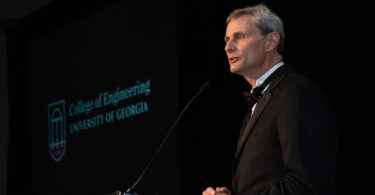
Good morning. I cannot tell you how genuinely thrilled and deeply honored I am to have been asked to deliver the annual Ralph McGill Lecture. I appear before you, quite frankly, with a bit of trepidation as well recognizing not only the accomplishments of my distinguished predecessor, McGill, but also those of the long list of well-known journalists who have preceded me at this
There will never be another Ralph McGill a man who stood at one of historys turbulent crossroads and chose the unpopular but righteous path, shaping a city as he went. But I would like to believe he would be pleased with the work I do. There is at least one way in which I emulate McGill. It is said that in his day, the Atlanta Constitution had two kinds of readers. There were those who just couldnt eat their breakfasts until they had read Ralph McGill. And then there were those who couldnt eat their breakfasts after they had read Ralph McGill. No doubt, I have that very same effect on some readers today. This morning, I want to talk about the role of the press in the post-September 11 world. In 1989, after the fall of the Berlin wall, state department historian Francis Fukayama wrote a widely-read essay called, The End of History. In it, he argued that liberal democracies based on capitalism were the natural end point of the evolution of human politics. With communism vanquished, Fukayama ventured, all nations would soon become liberal democracies and international conflict would end. Would that it were so. We now know that Fukayama was either dangerously naive or foolishly optimistic. But he might have been on to something if, at the beginning of the decade of the 1990s, he had written an essay called The End of News. For the collapse of the soviet empire allowed America to lapse into a self-indulgent concern with issues of personal comfort and prosperity that left no room for interest in foreign affairs. Or even the important affairs of the republic. News organizations gave up their historic roles as government watchdogs and conduits of critical information to give news consumers what we believed they wanted. Foreign news coverage disappeared from the big threeTVnetworks and shrank on the pages of mainstream newspapers. Neil Hickey, of Columbia Journalism Review, examined the cover stories of time magazine between 1987 and 1997. In 1987, Time had eleven covers relating to foreign news; in 1997, only one. Lets review the major news stories of the last decade or so. There was the trial of O.J. Simpson ? Frequently referred to as the trial of the century. The excessive coverage of the trial was sometimes justified by news executives as an occasion to teach Americans how their criminal justice system worked. Having covered a few criminal trials in my days as a reporter, I can assure you that the trial of O.J. Simpson, like trials of all wealthy criminal defendants, revealed nothing about the routine workings of the criminal justice system. You would learn more about that from watching entertainment dramas such as "Law and Order" and "NYPD Blue." There was the trial of Marv Albert ? A TV sports commentator with a very bad toupee ? For sexual misconduct. I dont think news executives even attempted to justify coverage of that event. And, of course, there was two years worth of relentless news coverage of a sexual scandal involving president Bill Clinton and a young white house intern named Monica Lewinsky. Who knows how many important developments in addition to the rise of a dangerous Islamic extremism we missed while we were hot of the trail of Bill Clintons libido. Before you dismiss my analysis of coverage of the Lewinsky scandal as the bitter rantings of a partisan, I want to remind you that, with my participation, the Atlanta Journal- Constitution editorial page called for Bill Clintons resignation in august 1998. I was as disgusted by his personal conduct as any one of you. But it is difficult to make a rational argument that Clintons personal sexual misconduct caused extension damage to the republic. There was alleged conduct by President Clinton that new organizations would have been justified in spending years to investigate, including improprieties in campaign fund-raising. The question of whether Clinton knowingly accepted funds from foreign governments does affect the republic. That is news. But that is more difficult to write about knowledgeably than sex. For one thing, to investigate campaign fund-raising, you have to be able to count. And after all, many of us majored in journalism because math was not a strong suit. For a while after the 1995 bombing of the Murrah federal building in Oklahoma, journalists did follow that crucial news story. Right up until the arrest of Timothy McVeigh. Then, the story lost its glamor. Except for his trial and later execution, we forgot about that major terrorist attack, failing to sustain our coverage of the right-wing hate groups that were briefly highlighted after McVeighs arrest. Wouldnt it be fascinating ? And frightening ? If the current anthrax attacks are coming from one of those home-crown hate groups? And what was the major news story of the summer? How quickly September 11 made the sexual conduct of a little-known California congressman named Gary Condit appear as unimportant, as superficial, as inane, as it was. Would that the story had been about the disappearance of a young woman named Chandra Levy, but we all know better than that. Nearly 100,000 Americans disappear every year, and we dont know their names. Once a sexual scandal involving a congressman became evident in the case of Chandra Levy, however, , we could not devote enough press attention to him. Notice I didnt say to her. To him. It would be easy enough for me to blame the sensationalized and dumbed-down news of the last decade on the demands of 24-hour cable news networks. Heaven knows, theyve done their share to contribute to a climate wherein sexual improprieties and celebrity divorces are mistaken for public affairs. But the simple truth is that newspapers also caved in to the pressure to give a reading public with attention deficit disorder entertainment rather than information. Newspapers, too, participated in the end of news. The good news is that September 11 proved that newspapers had not forgotten how to cover real news. Every major daily around the country from the New York Times and Washington Post to the Atlanta Journal- Constitution and Portland Oregonian went into overdrive immediately. Within the first week, the editors of the Atlanta Journal- Constitution, Ron Martin, John Walter and Julia Wallace, had sent reporters to ground zero in New York, aboard to Pakistan, and organized teams to go all over the country. Indeed, these are exciting times for newspapers because we have been handed a perfect opportunity to return to the fundamental missions upon which we were founded giving citizens the news they need to be informed participants in a democracy. I do not mean to sound callous. I certainly do not intend to sound gleeful given the horrendous atrocities of that fateful Tuesday morning. Thousands of families mourn, others struggle to reclaim their livelihoods and the entire nation has been shaken. But in the wake of this calamity, Ive seen newspapers do some of their best work since the volatile 1960s, with headlines of civil rights, assassinations and Vietnam. The challenge for newspapers is staying focused in the days ahead, as the war on terror ebbs and flows, and the natural longing for normalcy is accompanied by a longing for a return to synthetic news. We would do our readers and all the citizens of this great democracy a grave disservice if we fail to cover the news that matters. After all, the united states might have been better prepared for the terrorist attacks of September 11 if the press had done the job it should have been doing in the last decade. As Washington post columnist Richard Cohen recently admitted, he ignored pleas from officials last year to write about efforts to combat terrorism. Cohen wrote: "I know a guy who was on one of those government terrorism commissions who used to say I ought to talk to him. I never did." I was busy, not just with Bill and Monica but with other things as well. . .Anyway, I never wrote about the terrorist threat to this country. I was negligent. But I was not alone. The press in general did a miserable job preparing the American people for what happened on September 11, Cohen said. There is so much for newspapers to cover in the aftermath of September 11. The press must be vigilant about attempts by the government to violate the civil liberties of immigrants of color ? Especially those of middle-eastern or Arab heritage. We have to watch out for the special pleadings of industries trying get tax breaks by wrapping their entreaties in the flag and patriotism. The press must be vigilant about threats to the civil liberties of American citizens, as we grant vast new powers to law enforcement agencies under the guise of protecting us from terrorism. The press faces a second challenge, as well staying fateful to our commitment to deliver clear-eyed and unbiased news coverage in a time of overwhelming pressure for a sycophantic patriotism ? A patriotism that never questions the president or the pentagon, never notices civilian casualties in our military actions, never grants an interview to our avowed enemy, Osama Bin Laden. In a powerful and persuasive op-ed piece in Sundays New York Times, Bob Giles, former editor of the Detroit News and current curator of the Neiman foundation, criticized broadcasters for refusing to air videotaped rants from Osama Bin Laden. "Why cant we watch Osama Bin Laden on American television?" Giles asked. He continued, and I quote: "White house officials called on network executives last month. . .The administration persuaded the networks that self-censorship was necessary to the war effort." Giles continued, noting that the most recent word from Osama Bin Laden a videotape aired in full on Al Jazeera, the Arab network, on Nov. 3 ? Was seen only in bits and pieces on American TV. It was curious that Americans were not allowed to view bin Ladens rant as he widened his criticism to include not just the united states but also the united nations. Giles said, and I quote: "American citizens missed important information about the person with whom our government is at war. . .The bush administration has itself sought to portray this conflict as global, not merely American, and to show Mr. Bin laden as an aggressor against the world. Mr. Bin Ladens recent statement gives much support to the administrations position, which makes it especially odd that the administration would want it kept from the American public." Giles added: "Openness should not be a casualty of war." End of quote. The de-emphasis on hard news coincided with the consolidations of major news organizations in huge conglomerates, the most noteworthy of which is AOL Time Warner. Thats such a behemoth that it is hard to know where it begins and ends. Its tentacles are spread throughout modern communications. Back in the day of Edward R. Murrow, news was delivered as a public service. Broadcast news divisions, especially, were not expected to make a profit. But after more and more news outlets were concentrated in the hands of publicly traded companies, that changed. The demands of stockholders are such that news organizations are pressed for higher and higher dividends. That means less emphasis on costly news-gathering and more emphasis on delivering a cheap product that news consumers will enjoy. As the employee of a family owned company, Cox Newspapers, I am blessedly shielded from some of those pressures. But for many news organizations, the pressure is intense. The challenge in the days ahead is to keep covering the news, no matter how much it costs. As President Bush has called on all of us to make sacrifices, perhaps the CEOs of these publicly traded news organizations can be persuaded to make small sacrifice by covering the news even though it eats into the profit margin. Im not suggesting that they stop making a profit, merely that they take a little less. Perhaps its a good thing my published isnt here to hear me say that. I can just here him now, saying, Cynthia, I make a sacrifice every time I put you and Mike Luckovich in the newspaper because youre busy running off readers. I close with a reminder that Ralph McGill lived and worked in a time or terrorism right here on the home front. If you doubt my comparison, remember the four little girls who were blown to bits right after Sunday school in the Sixteen Street Baptist Church in Birmingham . McGill, too, came under a great deal of pressure, not just from the rabid segregationists, but also from many moderates who told him his columns only made matters worse. McGills constant agitation, those self-proclaimed progressives said, would just increase the resistance to Negro citizens getting their rights. If McGill would just cool off and shut up, Negroes would be better off, he was told. But he would have none of it. One of his most famous columns was written after other acts of domestic terrorism ? The bombing of a Jewish synagogue and a school in Tennessee. The column, headlined "a church, a school," was cited by the Pulitzer committee in awarding McGill the Pulitzer prize in 1959. McGill wrote: "Dynamite in great quantity ripped a beautiful temple of worship in Atlanta. It followed hard on the heels of a like destruction of a handsome high school at Clinton, Tennessee. The same rabid, mad-dog minds were, without question, behind both. They are also the source of previous bombings in Florida, Alabama, and South Carolina. The schoolhouse and the church were the targets of diseased, hate-filled minds. "Let us face the facts. This is a harvest. It is a crop of things sown. It is the harvest of defiance of the courts and the encouragement of citizens to defy law on the part of many southern politicians. It will be the acme of irony, for example, of any one of four or five southern governors deplore this bombing. It will be grimly humorous if certain attorneys general issue statements of regret. And it will be quite a job for some editors, columnists and commentators, who have been saying that our courts have no jurisdiction and that the people should refuse to accept their authority, now to deplore. It is not possible to preach lawlessness and restrict it. To be sure, none said go bomb a Jewish temple or school. But let it be understood that when leadership in high places in any degree failed to support constituted authority, it opens the gates to all those who wish to take law into their hands. There will be, to be sure, the customary act of the careful drawing aside of skirts on the part of those in high places. How awful! They will exclaim. How terrible. Something must be done. But the record stands. The extremists of the citizens councils, the political leaders who in terms violent and inflammatory have repudiated their oaths and stood against due process of law have helped unloose this flood of hate and bombing." End of quote. Thats what McGill had to say. And it his clear-eyed courage that helps to inform my work today. Thank you. |
||||||||||||||||||
|
UGA TODAY ] News Bureau ] Master Calendar ] Columns ] Georgia Magazine ] UGA Home ] Admissions ] Directories ] Sports ] Alumni ] Weather ] Search this site ] Search UGA sites ] SPECIAL REPORT / September 11, 2001 : UGA Responds is produced by the UGA News Service, a unit of UGA Public Affairs. Questions or comments should be directed to uc@www.uga.edu. Copyright 2001 University of Georgia. All rights reserved
|
|||||||||||||||||||