Research in the Rohani lab focuses on population biology, usually of host-natural enemy interactions, with a view to understanding fundamental processes in population ecology and evolution. First, we use a combination of mathematical modelling and data analysis to understand the ecology and evolution of infectious diseases of humans, including childhood infections and emerging infectious diseases. Second, we use a combination of laboratory experiments and statistical and mathematical models to understand the evolution, persistence and competitive coexistence of insect-parasitoid-pathogen assemblages.

Dynamics of Human Infectious Diseases

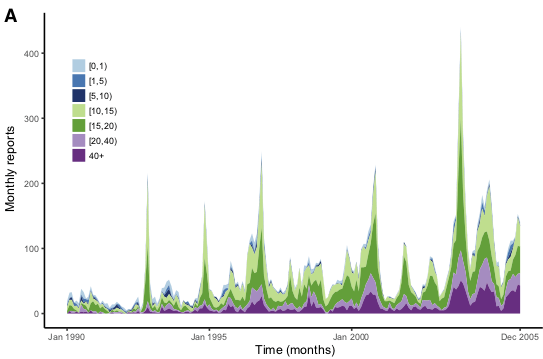
Much of current research in the lab is based on understanding long term data sets on the spatio-temporal patterns of morbidity and mortality caused by the great childhood microparasitic infections (such as measles and whooping cough).   The analyses of these data have provided interesting insights into the mechanisms of disease transmission and the ecology of infectious diseases.  This work has demonstrated:

  • Epidemics of measles are strongly driven by the interaction between the recruitment rate of susceptibles and seasonal changes in contact rates.  Taking into account systematic trends in per capita population birth rates or the onset of large scale immunization programmes explains the dynamical transitions observed in measles data in England & Wales (Earn et al. 2000) and the Niakhar region of Senegal (Broutin et al. 2005). 
  • Whooping cough epidemics show the opposite spatio-temporal pattern to measles both before mass vaccination and in the vaccine era (Rohani et al. 1999).  This has been suggested to be due to increased susceptibility of whooping cough dynamics to stochasticity, arising from its differing life-history traits (Keeling et al. 2001; Rohani et al. 2002). The resonance consequences of changes in the relative transmission rates and infectious periods is currently under investigation (Choisy et al. 2006).
  • The spatio-temporal dynamics of measles and whooping cough in the USA appear to follow the same patterns. We are currently in the very early stages of examining long-term data for childhood infections in different states, with a view to examining the spatial hierarchies of transmission and the consequences of national immunization schemes for transmission dynamics (Pej Rohani, in collaboration with Marc Choisy).
  • In contrast to the generally accepted wisdom that whooping cough vaccines only protect against disease (and not transmission), our ecological analyses of data from England & Wales (Rohani et al. 2000) and Senegal (Broutin et al. 2004) both show strong signatures of dramatically reduced whooping cough transmission in response to vaccination. We are also interested in explaining the dynamical and persistence consequences of the distribution of infectious period in whooping cough (Nguyen & Rohani 2008).

  • Possible ecological interactions between unrelated infections, arising from unavailability to contract a disease following infection with another.  Theoretical analyses of such mechanisms predict pronounced phase-differences between different disease (or strains of the same disease), which are consistent with observed patterns in mortality data.  We are currently exploring a number of aspects of this phenomenon, as relating to childhood infections (Huang & Rohani 2006), antigenically polymorphic infectious diseases such a dengue (Wearing & Rohani 2006), and the development of statistically robust methodology for the detection of “interference” effects (Vasco, Wearing & Rohani, in prep ).
  • Using game theoretic approaches to study co-evolutionary dynamics in host-pathogen systems, we have demonstrated that infectious diseases can give rise to increased sociality in the host population (Bonds et al., 2005). This work has also explored the coevolutionary mechanisms giving rise to sterilisation and gigantism in hosts as a result of infections (Bonds 2006).
Host-parasitoid assemblages

We have established laboratory populations of insect host-parasitoid-pathogen assemblages. This work is in collaboration with Dr Steve Sait (Department of Biology, University of Leeds, UK). We are studying the Indian meal moth, Plodia interpunctella (a stored-product pest) and its competitor, the Almond moth, Ephestia cautella. Both species are subject to attack by a suite of natural enemies, including a solitary ichneumonid wasp (Venturia canescens) and and two species of baculoviruses (the P. interpunctella granulovirus and E. cautella nucleopolyhedrovirus; PiGV and EcNPV respectively).

Using this system, we have explored a number of ecological questions, typically by testing model predictions in the laboratory population assemblages. These topics include:

  • Understanding the dynamical consequences of specialized versus generalist natural enemies (Rohani et al. 2003; Wearing et al. 2004a)
  • Exploring the importance of development variability and demographic noise in determining the fluctuations observed in our laboratory populations (Wearing et al. 2004b).
  • Examining the role of periodic resource dynamics in generating cycles of different periods (Wearing et al., in prep).
  • Understanding the co-evolutionary consequences of seasonality. We are using mathematical models to explore how temporal fluctuations affect the (co-)evolutionary dynamics of host resistence and parasitoid virulence. Seasonality affects our system in two separate mechanisms: (i) periodic changes in pathogen transmission and parasitism, and (ii) temporally varying environment. This work is done in collaboration with Dr Steven White, a postdoc at the University of Leeds.
  • Currently, Jerome Niogret is carrying out experiments to examine the life-history consequences of resistance to parasitism in Plodia.

Work on host-parasitoid-pathogen assemblages has been funded by two grants from the UK's Natural Environment Research Council.