Monday, October 30, 2000
Clearing another path
Vet prof demonstrates value of support organizations
University’s ‘teacher of teachers’ announces retirement in June
First director of Institute of Government dies
Campus Closeup
Kudos
New associate dean leads expansion of business executive program
Musically reclined

UGA’s ‘Mr. Climate’
David Stooksbury keeps the public informed as state’s climatologist
By Beth Roberts
beth@uga.edu

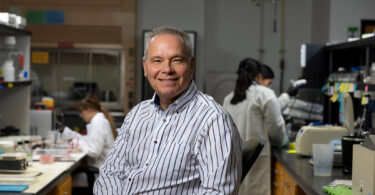
David Stooksbury joined the department of biological and agricultural engineering in the College of Agricultural and Environmental Sciences last year as an assistant professor and climatologist for the state of Georgia. With two bachelor’s degrees and a master’s from UGA (and a Ph.D. from the University of Virginia), he says he’s come home. He recently talked with Columns about his responsibilities and interests.

Columns: I know you are Georgia’s state climatologist--can you pinpoint the difference between climatology and meteorology for me?
Stooksbury:
The difference is more historical than modern. Climatology came out of geography and meteorology came out of physics, but modern climatology and modern meteorology have merged to the point that the distinction is mostly a question of time scale. People use the term meteorology for the short term. Meteorology deals with the weather, what’s happening right now and for maybe 48 or 72 hours. Anything beyond that would be considered climatology.
As a climatologist, when I’m working on drought concerns, today’s weather doesn’t have any impact. We’ll have to have four or five months of above-normal rainfall before we’re coming out of the drought. It’s a question of the time scale.
And that leads to a difference in interest. A climatologist quite often is looking at impacts--how this is impacting farmers or home gardeners or the economy. Many college departments have changed their name from meteorology to atmospheric sciences, a more general term. Our introductory classes at the university are called “Introduction to Weather and Climate”--the two go together.

Columns: So climatology deals with climate, not weather. What does the state climatologist do?
Stooksbury:
In many ways, the state climatologist is the state trivia officer--I get calls about astronomy, about earthquakes, about daylight savings time. There’s a lot of variety.

Columns: So you’re the state expert on weather and climate questions, the person the media can contact with questions. Do you work with the weather service?
Stooksbury:
Yes. I also keep in touch with the Georgia Emergency Management Agency, to make sure that we’re all on the same page. We want to get a clear message out to the public.
During the drought, the university has been one of the lead agencies in getting information to the public. I worked very closely with the extension service in putting up the university’s drought page (www.griffin.peachnet.edu/caes/drought/), which has received outstanding comments across the state. We’ve been the primary source of information--keeping the press up-to-date and educating the public. Since I came home that has probably taken up the largest amount of my time.

Columns: But you also teach, like any other faculty member?
Stooksbury
: I teach environmental microclimatology--the climate near the ground, important obviously for plants and animals--and atmospheric thermodynamics and atmospheric physics.
Another thing I’ve been working on is a certificate program in atmospheric sciences that we’re developing. The undergraduate program is now being considered at the board of regents, and we hope it will be approved by the end of the year. And the graduate certificate has been approved.
What’s unique about a certificate program is that the students are not atmospheric sciences majors--they earn the certificate along with their major. I think that is a strong niche for Georgia. In the southeast there are really big programs at North Carolina State and Florida State, but we’re not trying to duplicate what they’re doing. We don’t need more programs like that--what we need are programs that reach out to other fields.
Many of the Georgia students will receive their degree in geography, along with the certificate. And those students will be at an advantage compared to students coming out of a straight atmospheric sciences program, because they will have the training, the skills, the insights that a geographer brings to the atmospheric sciences. A student who wants to become an atmospheric physicist can major in physics and get the certificate. At Georgia there will also be many certificate students in agriculture. The UGA program is unique in that a student can major in crop science or animal science and also get the certificate--those students will truly be trained as agricultural meteorologists, not just meteorologists. We have a program in environmental health, and those students can study environmental health issues, concerns and problems, but also have the technical knowledge that comes with the atmospheric sciences certificate.

Columns: That sounds truly interdisciplinary--geography and physics from the College of Arts and Sciences, as well as departments in the College of Agricultural and Environmental Sciences.
Stooksbury:
And the School of Forest Resources is involved also--three colleges, eight academic units. There are two places to study hydrology at the University of Georgia--forestry and engineering. Students who specialize in hydrology can pick up their atmospheric sciences certificate, and that will be a hot combination. The weather service is responsible for flood forecasting and needs hydrologists, and they would much prefer to have somebody with academic training in both hydrology and meteorology.
Even as a student I realized how much was available at the university in different academic units, but it was never packaged in a way that a student could take advantage of it. Now it’s packaged, and it meets all the various professional standards. And I think it will give our students an advantage, because they are going to be cross-trained.

UGA Today ] News Bureau ] Master Calendar ] Columns ] Georgia Magazine ]
UGA Home ] Admissions ] Directories ] Sports ] Alumni ] Weather ]
Search this site ] Search UGA sites ]

Developed by University Communications News Bureau at the University of Georgia.
Beth Roberts: Columns editor, Juliett Dinkins: Columns managing editor,
Janet Beckley: Columns art director.
This site works best with the latest version of
Netscape Navigator 4.0 and Microsoft Internet Explorer 4.0.