By Phil Williams
In the third grade, Ellen Sutherland discovered turtles--not the swamp and lake variety, but the majestic and endangered sea turtle. Why were such elegant and docile creatures disappearing?
Life-long interest
She leaped headlong into a study of sea turtles but soon found herself interested in all creatures great and small, on land or sea. By the 11th grade, she had founded an Adopt-A-Stream Club at North Springs High School near Atlanta.
Now a junior at UGA, she has continued her passionate interest in the worlds of soil, water and air by forming Eco-Reach, a rapidly growing program that is helping UGA student and faculty volunteers to share the science of ecology with students from kindergarten through the 12th grade.
"The graduate and undergraduate student volunteers who are working on this give so much of themselves," says Sutherland, who is working on undergraduate and master'ås degrees in ecology simultaneously. "They do it out of the goodness of their hearts, and they have so little time to spare."
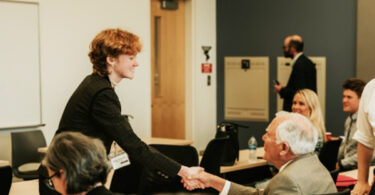
Photo: UGA junior Ellen Sutherland organized the Eco-Reach program to take student and faculty volunteers to local schools to
share their knowledge of ecology. Here she works with students at Barnett Shoals Elementary School. Photo by Rick O'Quinn.
Local presentations
The group has made numerous presentations already in AthensClarke and nearby counties. Volunteers speak on everything from the natural history of birds to the microbial world of soil.
Sutherland, a UGA Foundation Fellow and a bundle of cheerful energy, leads a life that makes most of us seem to be in slow motion. A top-of-her-class student since childhood, her interest in biology became a passion when, as a high school senior, she managed to hitch on to a UGA-sponsored trip to the Florida Keys with older brother Rob (now a Rhodes Scholar studying in England) and his professor, Bill Fitt of the Institute of Ecology.
In order to study marine biology, she had to conquer more than Florida Bay.
"I was always afraid of the ocean," she says, smiling. "I didn''t like getting in past my ankles, and I''m still not over my fear altogether. Every time I go diving, I still feel this fear of the unknown."
The unknown, however, has never kept her from leaping in. Sutherland came to UGA with so many advanced-placement credit hours that she spent her freshman year taking only ecology courses. By spring quarter that year, she was already teaching a lab section of Ecology 350, and since then she has done research on jellyfish as bio-indicators of pollution and worked on her master''s thesis on pollution caused by large swine farms. She assisted Georgia Rep. Denny Dobbs in drafting a bill to regulate such farms--the measure is now making its way through the Georgia General Assembly.
In her spare time, Sutherland served as a mentor in AthensClarke County schools. Her love of working with younger students led her to form Eco-Reach.
"At first, we just sent out about 100 brochures, and there weren''t many calls from the schools," she says, "but the word soon began to spread. Last year we had more student volunteers here than we had talks to give. But that gap is closing. We expect to be very busy in April, around the time of Earth Day."
Faculty support
The Eco-Reach program has gotten assistance from a number of supportive faculty members at the Institute of Ecology, and teachers and parents in local schools are enthusiastic.
While the Eco-Reach volunteers already speak on numerous topics, additional subjects are being planned, in such areas as science careers, the natural world of Cumberland Island and restoration efforts in the Everglades.
Sutherland will spend this spring quarter at Oxford University in UGA''s Studies Abroad Program, but she''s leaving Eco-Reach in the capable hands of another ecology graduate student, Theresa Thom.
With another full year left to finish her double degrees at UGA, Sutherland looks forward to extending Eco-Reach and planning her own future, which could include anything from environmental law to teaching.
"I do have a hectic life, but in truth, I love it," says Sutherland.
For information on Eco-Reach, phone the Institute of Ecology at 542-2968.