|
By Helen Fosgate
If the work of UGA researchers pans out, fish may soon supplement mice for screening chemicals in the lab. A team of UGA toxicologists has transferred genes from bacteria into the Japanese medaka, a tiny freshwater fish, to help evaluate the genetic health risks of chemicals in the environment.
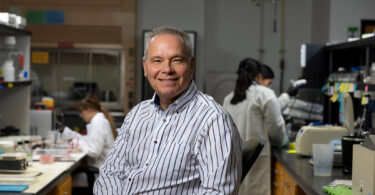
Transgenic fish offer nearly every kind of exposure route as mice, and, in tests, they can be exposed at low-dose, realistic levels, says Richard Winn, an environmental toxicologist in the Warnell School of Forest Resources.
Winn says fish are also cheaper to use, costing just pennies a year, compared to about 20 cents a day to maintain lab mice, and they are less sensitive, politically, than mammals for use in biomedical research.
The transgenic fish carry specific DNA sequences that serve as targets for DNA damage or mutations. Researchers first expose the fish to a potential contaminant, then analyze tissues for mutations in the indicator bacteria. Because the same detection system is used in lab mice, Winn says, comparative studies are now possible using two different species.
The fish can be used for screening organic materials such as PCBs, as well as heavy metals, radiation, herbicides and pesticides. They are especially useful, Winn says, in screening for toxicity the more than 2,000 new chemical compounds introduced in the market each year.
Its the canary in the coal mine approach to screening that applies to humans, he says. We would never release the modified fish into the wild. In the lab, they act as surrogates for wild fish populations.
Winns group has funding through the Georgia Biotechnology Center of the Georgia Research Alliance for a new $1.3 million facility, dubbed ABEL--Aquatic Biotechnology and Environmental Laboratory--to be built at the Warnell Schools Whitehall Forest. It will include aquatic toxicology laboratories for biological testing under highly controlled environmental conditions. The lab will accommodate freshwater and saltwater species, including specialized strains developed for aquaculture, environmental-hazard assessment, biomedicine and biotechnology.
This facility will serve as a national center for cooperative, multidisciplinary research, says Winn. It will also help in the development and transfer of technology to existing and emerging industries.
The Japanese medaka has already been widely used for cancer research, and Winn realized its potential as an alternative to rodents for screening chemicals. Initially, researchers took two bacterial genes, LacI and cII, the same genes used in mice to detect chemically induced mutations, and spliced them into a bacterial virus. When injected into medaka eggs, the bacteriophage entered the eggs nucleus. Some fish that developed from the eggs carried the new genes in all their cells. These fish appear to exhibit a low frequency of spontaneous mutations, which means they can report very low levels of new mutations.
Next, scientists added very small quantities of a standard mutagen, N-ethyl-N-nitrosourea (ENU), to the fish tanks. They waited from one to 16 hours, then ground the fish up and recovered the bacterial DNA for analysis. Researchers found that they could detect even the slightest genetic changes, noting a two- to threefold increase in mutations at low exposures to this chemical.
Winn has also developed a transgenic medaka and a saltwater fish, Fundulus, with a third gene, LacZ, which he says can detect radiation-induced gene damage. And while he cautions that more work is needed before the fish find widespread use as test subjects, Winn believes fish are the future of environmental testing.
We now recognize the need for a battery of tests and subjects to get meaningful information, says Winn. Were not so much married to the method, but to getting answers.
|
|