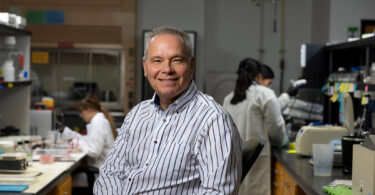
Athens, Ga. – A research group led by Stephen Dalton,
professor and Georgia Research Alliance Eminent Scholar of Molecular Biology at
the University of Georgia, has been awarded $9.2 million as part of a major new
research grant by the National Institute of General Medical Sciences, part of
the National Institutes of Health.
Dalton’s
group, headquartered in the department of biochemistry and molecular biology,
will address the molecular underpinnings of the early steps that stem cells
take in becoming specialized cell types. The scientists will also seek to
identify the genetic and protein modification patterns that accompany this
process of differentiation.
The new grant in UGA’s Franklin College of Arts and Sciences
is part of $27 million in funding awarded to the University of Wisconsin, UCLA
and UGA that NIGMS has added to its ongoing effort to uncover the basic biology
of human embryonic stem cells.
“Our program will offer training for scientists seeking to
gain expertise in the specialized techniques needed to work with embryonic stem
cells and will serve as a source of reagents, technical support and methodology
development,” said Dalton, who is also a Georgia Cancer Coalition Distinguished
Scholar and a member of UGA’s developmental biology program.
The results of all three new programs are expected to deepen
existing knowledge of the unique properties of stem cells and will be important
to researchers trying to develop stem-cell-based therapies.
“This program project grant is important for a number of
reasons,” said David Lee, UGA vice president for research. “Certainly it
highlights the expertise in stem cell biology and glycomics at the University of Georgia. But perhaps more important, it
is cleverly designed to promote stem cell research throughout the Southeast.
One of the core facilities funded by the grant is specifically tasked with
developing new stem cell technologies that will be disseminated to researchers
across the region via the new Southeast Stem Cell Consortium, which Professor
Dalton chairs. We are extremely pleased by the leadership provided by Dr.
Dalton in an area that offers so much promise for human health.”
Dalton’s
position as a leader in stem-cell research has been solidified with the recent
establishment of the Southeast Stem Cell Consortium. The consortium has strong
interests in the basic biology of stem cells, their utility as a model for
studying mammalian development and their potential as a cell source to develop
therapies for degenerative disease and repair of chronic injury. Focus areas
include diabetes, cardiovascular disease, spinal cord injury and
neurodegenerative disease.
“This
is an innovative program that focuses on an understudied area of stem cell
biology,” said Marion Zatz, Ph.D., who oversees stem cell grants at the
National Institute of General Medical Sciences of the National Institutes of
Health. “By looking at how proteins are modified by sugar molecules as stem
cells differentiate, Dalton’s
team could help us understand how the many distinct cell types in our bodies
are formed.”
Dalton’s research group at
UGA focuses on the uses of stem cells in understanding diabetes and
cardiovascular disease. One current project involves finding ways to use stem
cells to repair the human heart.
“The heart is an organ that doesn’t repair itself,” said Dalton. “But we’re
studying a resident population of stem cells that have the capability of
dividing and turning into cardiac cells. Theoretically, they could be used to
help the heart repair itself after a heart attack.”
The new programs join an NIGMS effort launched in 2003 to
explore the basic molecular and genetic features of human embryonic stem cells.
Prior to the latest awards, the initiative has included six exploratory
centers, two multidisciplinary research programs and several independent
research projects and supplements.
To learn more about the Southeast Stem Cell Consortium see http://www.sestemcells.uga.edu/.
##